The new chairperson of the AO Spine International Board has pledged to significantly transform surgeons’ professional leadership skills worldwide.
Argentine neurosurgeon Dr Juan Emmerich will take up the role in July 2024.
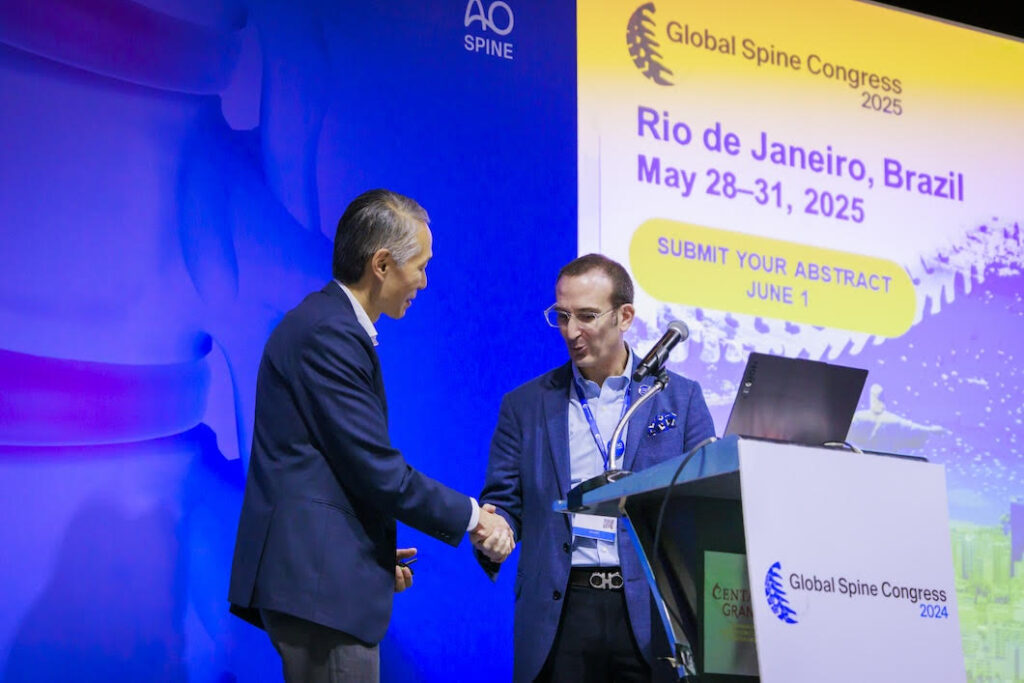
With a keen interest in leadership, faculty development, personal growth and technology, he has already laid out his leadership vision for the next three years.
His tenure promises to foster growth, collaboration and technological advancement, ensuring that AO Spine remains at the forefront of spine surgery and research.
For him, great leadership is the cornerstone of surgical success, and he laments the lack of professional training in this area.
Speaking to Surgery International at the recent AO Global Spine Congress (GSC) in Bangkok, he shared his thoughts on equipping surgeons with the skills necessary for effective leadership.
He said: ‘Most of us have a leadership position in our department but no professional training; it doesn’t make sense. We spend hundreds of hours dedicating ourselves to preparing a particular dish that we only eat every four years, yet we don’t practise for things we eat every day.’
He advocates for comprehensive training programmes focusing on technical skills and essential leadership qualities, developing leaders who can navigate the complexities of different cultures and generational dynamics within the medical field.
He explained: ‘We are working very closely with AO to give to our surgeons, especially those in leadership positions, the skills to be a better leader, to build a better team, to work with different cultures and to understand the complexity every time we take a decision. We must improve our leadership capacities, especially for the next generations.’
Currently serving as chairperson-elect, Dr Emmerich’s journey with AO Spine is marked by his capacity for leadership roles.
He has been an active member of the AO Spine community for many years, serving as the chairperson of AO Spine Latin America. His tenure was characterised by a commitment to educational excellence and faculty development.
In 2016, he was honoured with the AO Spine International Educator of the Year Award, reflecting his dedication to teaching and mentoring the next generation of spine surgeons.
In the conversation, he also highlighted the importance of embracing new technologies such as endoscopy, robotics, virtual reality, and augmented reality in spine surgery, but he was keen to stress the need for critical evaluation in their implementation.
New technologies are on the rise, but the pathologies are the same as they were 40 or 50 years ago. So, we are dealing with the old pathology that we deal with every day, but with new tools, endoscopy, and robotics. Everyone is excited, and it’s nice to see how this will evolve in the next couple of years because the latest technology is always a challenge.
‘We see new approaches using virtual reality, augmented reality, robotics, and other new and fancy technologies – and they look amazing. However, the big ‘if’ is whether they will be helpful for our patients. That, for me, is a challenge, and we must ensure that any technology is the best option for them.’
His approach to addressing global spine issues is rooted in a deep understanding of developed and underdeveloped regions. Universal challenges affect patients worldwide, irrespective of their economic status. Recognising the disparities in healthcare access and outcomes, he said there is a real need for global cooperation and shared knowledge.
‘In rich countries, there are places that are underdeveloped and in underdeveloped countries, there are wealthy areas. Adult scoliosis is a huge problem because people live longer, and degenerative spines worldwide are a concern. Whether you live in a developed or underdeveloped country, these are two issues we all need to address as a global community.’
GSC 2025 Abstracts
Abstract submission is now open for GSC 2025 taking place in Rio de Janeiro. Be the first to submit your abstract to the leading spine event of 2025. There are several presentation formats, including e-posters, oral presentations, and our all-new rapid-fire sessions. If accepted, authors will have the flexibility to present their research in either Spanish, Portuguese or English. However, please note that abstracts can only be submitted in English. Find out more here.