For more than two decades, the defining question in surgical robotics has been remarkably simple: can we build a better robot? Hamlyn 2026 suggested we have finally begun asking a more important question.
Can the robot understand surgery?
That subtle change may prove to be one of the most important inflection points in modern surgery. The 18th Hamlyn Symposium on Medical Robotics, held under the theme Medical Robotics: The Complex Journey from Ideation to Value Creation, revealed a discipline beginning to move beyond mechanical innovation towards clinical intelligence.
For many years, progress in robotic surgery has been measured in hardware. Smaller instruments. Better articulation. Greater precision. More degrees of freedom. Those advances continue at pace. Sessions on continuum robots, soft manipulators, flexible endoscopy, robotic catheter systems and novel surgical instruments demonstrated just how rapidly engineering continues to evolve. Yet, despite these impressive developments, another message quietly emerged throughout the meeting.
The robot is no longer the innovation. The intelligence running inside it is.
Artificial intelligence was no longer confined to a single session. It was woven throughout the programme. Computer vision, scene reconstruction, cognitive modelling, autonomous assistance, workflow analysis, simulation, digital twins and foundation models appeared not as isolated research projects but as components of a connected ecosystem. Collectively they point towards robotic platforms evolving from mechanical devices into intelligent operating systems for surgery.
Perhaps the clearest example came from Katherine Kuchenbecker's keynote on augmenting surgical perception. For decades, robotic surgery has accepted the loss of tactile sensation as the inevitable compromise of minimally invasive surgery. Her work challenges that assumption through haptic feedback, enhanced visualisation and multi-view imaging. The implication is significant. Future robotic systems may not simply replicate the surgeon's senses. They may enhance them, presenting information beyond the limits of human perception alone.
That philosophy echoed throughout the scientific programme. Presentations explored three-dimensional reconstruction from endoscopy, tissue tracking, ultrasound fusion, surgical scene understanding and learning-based navigation. Individually these represent incremental advances. Together they suggest something much bigger. The operating theatre is becoming a data-rich environment in which anatomy, workflow and decision-making are increasingly computationally interpretable.
The first generation of surgical AI sought to identify pathology. The second learned to recognise anatomy. The next generation will understand context.
This evolution also changes how autonomy should be viewed. Public discussion often frames autonomous surgery as a future replacement for surgeons. Hamlyn presented a far more realistic picture. Artificial intelligence is learning to assist before it learns to replace. Automated tissue tracking, robotic ultrasound guidance, intelligent suturing, workflow recognition and motion compensation all represent forms of supervised autonomy. They reduce repetitive cognitive workload while leaving judgement, adaptability and accountability firmly in human hands.
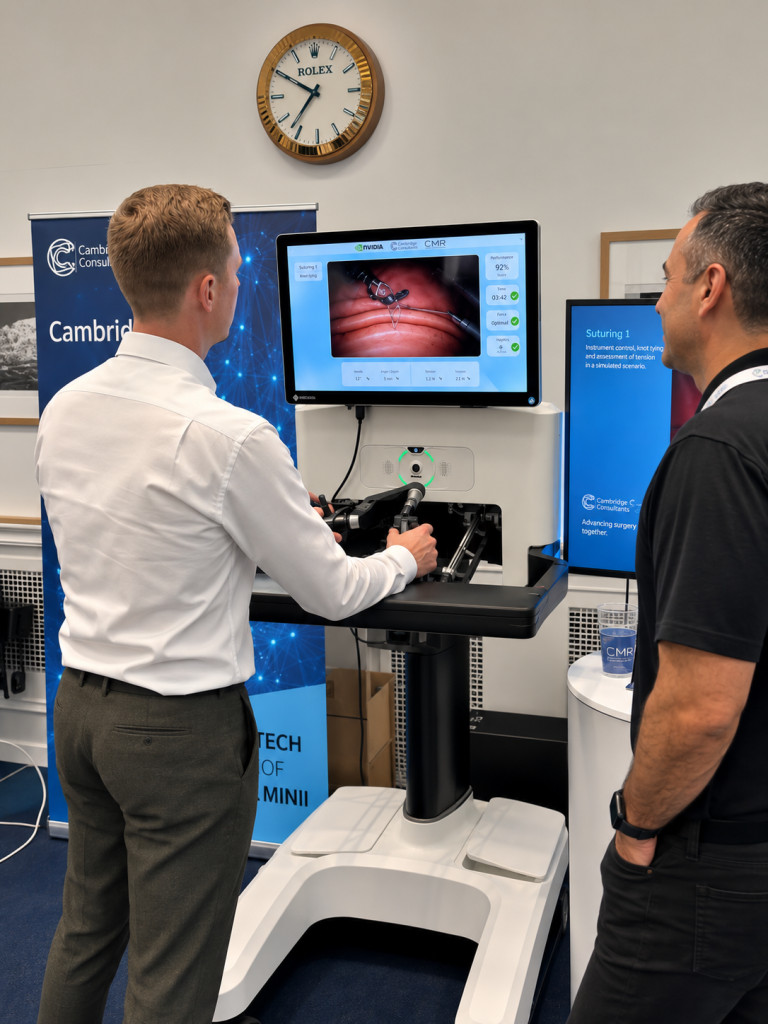
Perhaps the most thought-provoking discussion occurred away from the main scientific programme during Cambridge Consultants' panel, The Prompted Surgeon: The Role and Risks of AI in the Future of Surgical Robotics. Importantly, the discussion moved beyond what AI can do and focused instead on what it should do. Trust, transparency, accountability, prompt engineering, automation bias and clinical governance are no longer abstract concepts reserved for computer scientists. They are rapidly becoming professional responsibilities for surgeons. The debate reflected an important shift. Artificial intelligence has moved beyond an engineering curiosity. It is now a strategic issue for the profession.
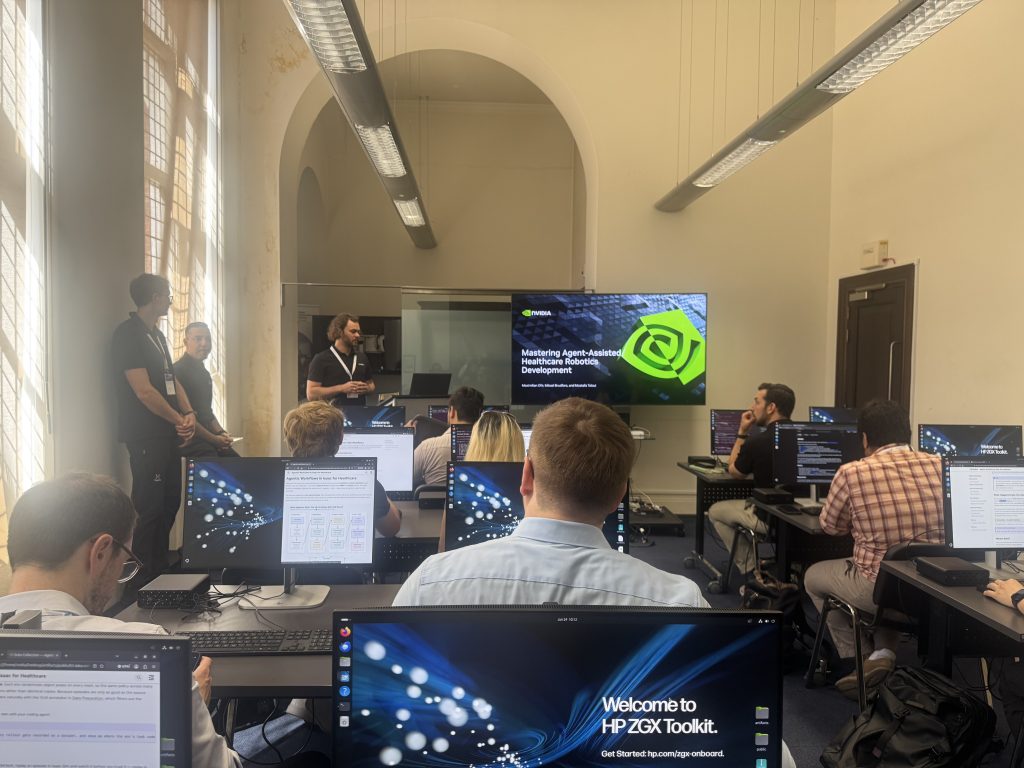
The introduction of the NVIDIA Training Laboratory reinforced the same message from a different perspective. Not because surgeons need to become programmers, but because computational literacy is rapidly becoming as important to academic surgery as statistical literacy became a generation ago. Tomorrow's surgical researchers will increasingly evaluate foundation models alongside clinical trials, understand synthetic datasets alongside patient registries and critically appraise AI validation studies alongside systematic reviews. The academic surgeon of 2035 will almost certainly look different from the academic surgeon of today.
This raises an uncomfortable question for the profession. Who will shape the future of surgical artificial intelligence?
Clinical intelligence cannot be developed in isolation from clinical expertise. Engineers can optimise algorithms. Data scientists can train models. Only surgeons understand the complexity of operative decision-making, anatomical variation, workflow and accountability. The greatest risk posed by artificial intelligence is not that surgeons will be replaced. It is that surgeons who fail to engage with AI may find themselves working within systems designed without sufficient surgical leadership.
Lord Darzi's conference theme therefore deserves particular attention. Innovation has never been the principal limitation within surgical robotics. Translation has. The introduction of the MRC-Hamlyn translational workshop acknowledged the well-known challenge of moving promising technologies across the "Valley of Death" between laboratory prototype and routine clinical practice. Discussions increasingly centred upon regulation, implementation, ergonomics, workflow and value creation rather than engineering novelty alone. That may represent the most important sign of maturity within the field. Success will no longer be measured by what can be built. It will be measured by what can be safely adopted and shown to improve patient care.
Henrik Christensen's closing lecture on embedded clinical intelligence neatly captured the direction of travel. The future operating theatre is unlikely to be defined by a single intelligent robot. Instead, robotics, imaging, electronic patient records, computer vision and artificial intelligence will function as integrated clinical systems that perceive, interpret and support decision-making throughout the patient's journey. In time, intelligent surgical environments may prove more transformative than intelligent surgical robots themselves.
One prediction now seems increasingly difficult to ignore. The next arms race in robotic surgery will not be mechanical. It will be computational. Data is the new surgical instrument.
If Hamlyn provides an early view of where surgical innovation is heading, the next challenge is ensuring those innovations become routine clinical practice. That conversation extends beyond engineers and roboticists to consultant surgeons, educators, NHS leaders and policymakers responsible for implementing innovation safely and effectively. This philosophy will underpin The Surgeon Show 2027, where many of the technologies emerging from centres such as the Hamlyn Centre will be explored through the practical lens of evaluation, adoption and service transformation.
An innovation cycle is never complete, but it gets close when it improves patient care. The robot is no longer the innovation. Clinical intelligence is. The next chapter of surgery will be written not by artificial intelligence alone, but by surgeons who understand how to use it.