A baby was partially delivered at 25 weeks for a procedure and then placed back in the mother’s womb before birth during ground-breaking foetal surgery.
Baby Cassian Joubert was diagnosed in-utero with Congenital High Airway Obstruction Syndrome (CHAOS).
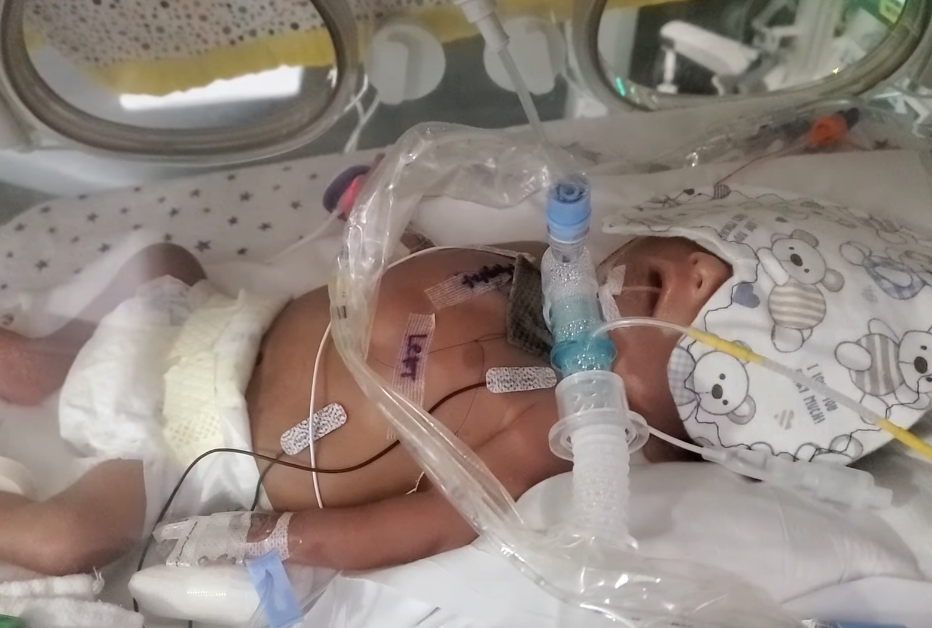
He survived thanks to lifesaving prenatal surgery, which involved a partial birth via C-section first, followed by his safe and complete delivery a few weeks later.
CHAOS is an extremely rare condition affecting 1 in every 50,000 babies, in which the baby’s respiratory tract is blocked by a membrane that obstructs the flow of foetal lung fluid, resulting in expansion of the airways and lungs.
In Cassian’s case, he was diagnosed at 19 weeks in-utero and underwent laparoscopic surgery three weeks later.
Surgeons attempted to cut through the tissue covering his trachea, but the membrane proved too thick.
Dr Emanuel Vlastos, director of the Orlando Health Women’s Institute Foetal Care Centre, said: ‘Their lungs get bigger, tighter, more pressure. It begins to squeeze the baby’s heart. Most of these babies die.’
So, in week 25, he carried out the pioneering intervention at Winnie Palmer Hospital in Orlando, Florida. With only Cassian’s head and neck exposed, Emanuel performed an in-utero tracheostomy.
Cassian was then safely returned to his mother’s uterus, where he remained until her waters broke, and he was born a second time.
Procedures like Cassian’s have been performed successfully only three times before. But this surgery was unique because Cassian was safely placed back in his mother’s womb to continue his prenatal growth, instead of being fully born.
In an Instagram post by Orlando Health Women’s Institute, they wrote: ‘When baby Cassian was diagnosed before birth with a rare condition called CHAOS, often described as “devastatingly fatal”, his family chose hope. Through a rare and novel in utero procedure, doctors placed a tiny tracheostomy to give him the chance to keep growing. When it was time, he was delivered through a specialised EXIT procedure so he could receive lifesaving support before even taking his first breath. 132 days in the NICU later, Cassian went home.’
A report from the National Institute of Health shows that parents are often advised to terminate the baby’s life, rather than fight to save it.