A British man is poised to make medical history again as he prepares to undergo a second multi-organ transplant to overcome a highly rare and aggressive form of cancer.
Adam Alderson, from Preston-under-Scar, North Yorkshire, previously made headlines in 2015 when he underwent surgery to remove a massive tumour and replace six organs. His rare cancer, pseudomyxoma peritonei (PMP), typically starts with a small growth in the appendix and is often diagnosed at an advanced stage.
Initially misdiagnosed with irritable bowel syndrome, Adam’s condition was discovered to be far more severe when specialists attempted to remove the tumour and found it had spread extensively.
Despite being given a terminal prognosis, he refused to give up and persuaded surgeon Brendan Moran to perform the pioneering operation. The initial surgery involved removing and transplanting his stomach, small and large intestines, pancreas, spleen, gall bladder, appendix, most of his liver and abdominal wall.

Now he faces the same operation – this time, replacing the same six organs plus his liver in what will be an unprecedented procedure.
Adam, who describes himself in his social media accounts as a ‘multi-visceral eight organ transplant survivor, cancer survivor, award-winning speaker, adventurist and charity fundraiser’, was one of the first known survivors.
He made a successful recovery and has dedicated time to raising funds for the Macmillan Cancer Support charity with his wife, Laura.
However, recent scans revealed Adam’s cancer had returned, and the next operation is expected within the next 12 to 18 months.
Surgeon Brendan Moran is a consultant surgeon at the peritoneal malignancy unit in Basingstoke and will lead the team.
As Adam prepares for this second critical surgery, he remains hopeful.
‘It’s a very slow-growing cancer so that it will buy me more time. I feel fortunate to be here still – I have Mr Moran and the team to thank for that.’
His refusal to accept the first medical opinion and his proactive approach to his healthcare has arguably proved pivotal in saving his life.
Adam says: ‘Something is missing in the pathway for second opinions, and the profession seems to fear them. However, patients must feel empowered to ask questions. I am an ADHD patient and was fixated on every detail of the surgery. When I was diagnosed, I educated myself on the disease and the medical terminology around it.’
His relationship with surgeon Brendan Moran was critical. Initially, when he suggested the disease was too widespread for surgery, Adam’s persistence made the difference, convincing the surgeon to attempt the multi-visceral transplant. At the time, only a handful of patients, including Steve Prescott, the late professional rugby league footballer, had undergone the operation.
Adam explains: ‘I was the fourth person to have this procedure but am the longer survivor because Steve died within three weeks as did another patient. However, the second patient did well for a couple of years before the disease came back, and she sadly passed away. I have six transplanted organs – stomach, small bowel, large bowel, pancreas, duodenum and abdominal wall. I don’t have a spleen, appendix or gallbladder.’
Post-operative recovery for Adam was far from straightforward. He faced numerous physical and emotional challenges, from dealing with the side effects of anti-rejection medications to managing the psychological stress of living with a life-threatening condition.
Living in a remote area of Yorkshire, his wife Laura cared for him and even trained in home palliative care, inserting cannulas, and getting a line in to administer fluids to Adam.
Unsurprisingly, he has found he has much to share with patients facing similar health challenges. His experience fuelled a passion for advocacy. He is active on social media and often advises many patients who face transplant surgery.
He said: ‘Not everyone is proactive, and I often see patients give up. You need strength, focus and determination to do something like this, so I try to motivate and push them.’
As a result of his work, he is helping raise awareness about organ donation and the need for better support systems for cancer patients. His fundraises for various charities and public speaking engagements are instrumental in bringing attention to these critical issues.
He has since travelled the world, and he and Laura have married. Adam said: ‘My mantra is “There is nothing like the fear of losing your life to motivate you to live your life”. I lost both my parents to cancer – my mum two years ago and my dad in my arms about 16 years ago. I am determined to beat it because of the loss.’
Adam is also part of the SENTINEL trial, a project investigating if skin patches can be used as an 'early warning system' to identify transplant rejection. An Oxford University team leads the study with five UK lung transplant centres and NHS Blood and Transplant.
He received his skin graft during the transplant procedure in 2015, which helped identify signs of rejection.
‘I feel safer knowing I have a tool available to tell if something is going wrong before it becomes too serious. It’s almost like an oil warning light on your car. Plus, having that visible reminder of how lucky I am is special,’
Gearing up for his second multi-organ transplant, he says his long-term relationship with his surgical team, particularly Brendan Moran, has given him the confidence to face this next challenge.
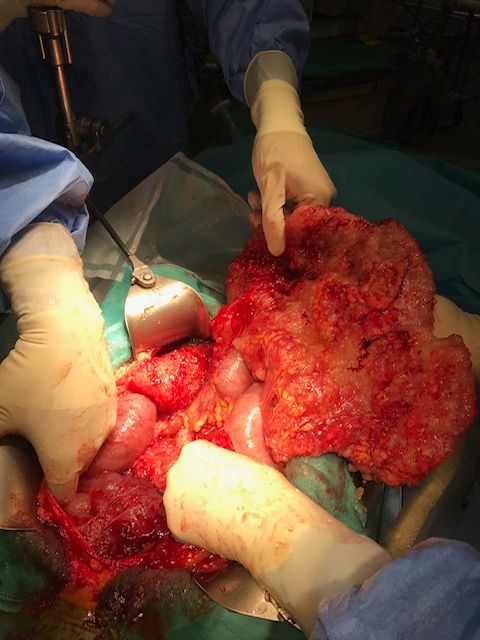
‘Communication with the surgical team has been vital. Anyone going through transplant surgery needs a good support network. Financially, it is a challenge, and the long road to recovery is full of hidden obstacles. My lowest ebb was when I was blue-lighted into my local hospital, throwing up my faeces. But something keeps pushing you on. And it is vital to appreciate that surgeons take a risk, too.
‘Brendan initially said the disease was everywhere, crushing the stomach and my mall bowel not working and told me he could not see a way to remove it, so it was a no at first. But I pushed him and begged him – short of putting him in a headlock, I was desperate to persuade him to operate. I had got to the point in 2015 that if I die on the table, so be it because my quality of life was so poor.’
Adam believes this time, the procedure will be more of a challenge.
‘I am still working [he works for NTH Solutions, an NHS subsidiary and has just set up his own business, @yakslifeltd, a clothing brand for patients with an ostomy, insulin pump and hernia support], walking my cocker spaniels and riding our horse, and most of the time, I feel OK. But knowing Brendan Moran and his surgery team are there for me helps because I have huge confidence in them. Over the years, I have built relationships with these people, and they will be with me for the rest of my life. We have been together and gone through a lot; strangely, Oxford offers comfort, and the hospital is almost like a second home.’
Adam will share his extraordinary story as the keynote speaker at The Transplantation Society’s 30th International Congress in Istanbul this September.