In the face of natural disasters or conflict, access to medical care can become severely limited or even non-existent.
However, Médecins Sans Frontières (MSF), also known as Doctors Without Borders, has been at the forefront of providing emergency medical assistance in challenging environments worldwide.

An international, independent medical humanitarian organisation that provides medical assistance to people affected by conflict, epidemics, disasters or exclusion from healthcare, one of the most remarkable innovations it uses is an inflatable emergency field hospital.
A modular, rapidly deployable medical facility, the inflatable hospital is a lifesaving piece of kit that enables medical staff to reach areas where traditional hospitals cannot operate.
In June, one of these inflatable hospitals was deployed to Adré, Chad.
Set up to cope with the influx of injured Sudanese people fleeing the conflict in West Darfur, it is a testament to innovation and adaptability.
The Adré inflatable hospital bolsters the existing capacity of the Ministry of Health hospital following the surge of war-wounded.
More than 15,000 people arrived in the area in just four days in June – and numbers continue to rise.
Among them are hundreds of war-wounded people crossing at a time, each requiring essential medical aid and many in need of urgent trauma surgery.

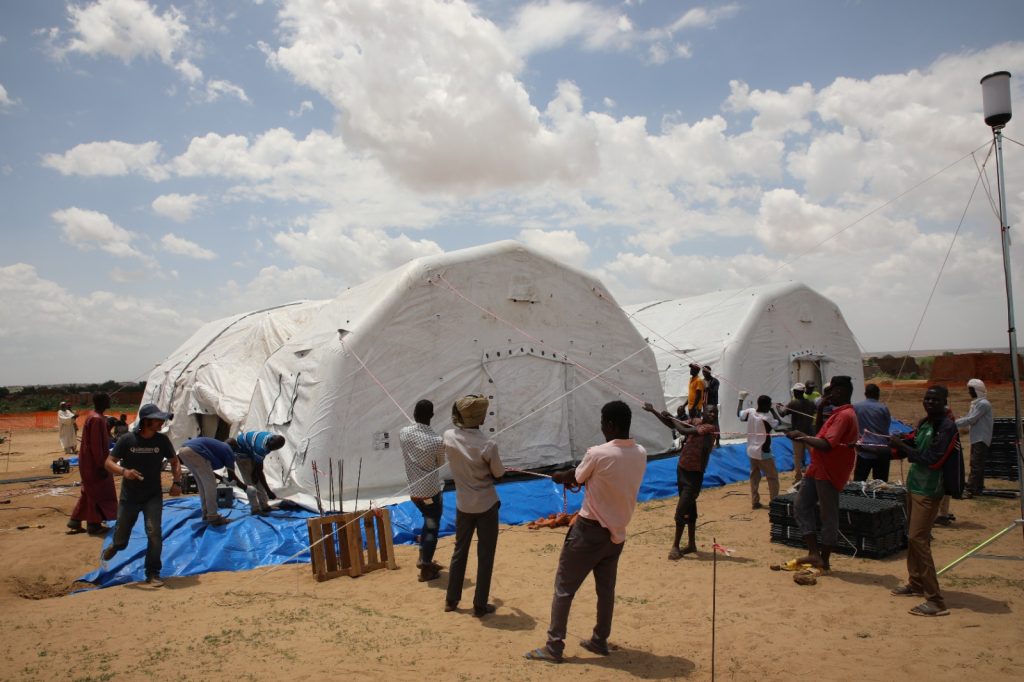
The 50-strong MSF team worked day and night in the remote region, initially prepping and levelling the sandy ground – the minimum requirement for deployment is 8,000 square metres of flat land – and inflating the multiple tents using large pumps that then serve as air-con units.
Once fully operational, around 200 wounded patients were immediately transferred to the inflatable hospital on 5 July.
The tents are called ‘inflatable’ because they are made up of arches, which, once inflated, create the structure of the building. The tents are made of weatherproof materials, making them quick to set up and easy to transport – ideal for emergency scenarios.
These innovative structures have been used to treat patients in the aftermath of natural disasters in countries such as Haiti, Philippines and Nepal.
Those on the ground often face many difficulties, including transportation logistics, rocky terrain, adverse weather conditions and limited access to water.
The medical team must therefore overcome many challenges beyond operating at the centre of chaos and conflict.
You can watch a 30-second video of the inflatable emergency field hospital here
Below, the team at MSF explain how they work amid natural disasters and warfare to deliver care to those most in need – and share their experience of providing critical trauma surgery to fleeing war-wounded from Sudan.
How does the inflatable hospital enable MSF to provide medical care in areas others can’t reach?
It is a complete modular hospital, pre-ready to be sent, that can be quickly deployed. As long as it’s possible to reach a location and has flat land of 8,000 square metres, this hospital can be set up almost everywhere. It’s often used during natural disasters when the existing health structures have been damaged or out of service. In the specific case of Adré, it expands the capacities of the existing hospital following an overwhelming influx of war-wounded people from neighbouring Sudan.
What are the specific features and capabilities of the inflatable hospital deployed in Adré, Chad?
The hospital is stocked with medical equipment and supplies needed to treat basic and complex conditions. The inflatable hospital has 200 beds, which include 30 beds for maternity, two operation theatres, one sterilisation room. It also has facilities such as X-rays, laundry, water storage and energy. The tents are independent from one another – hence there is flexibility to change and can be adapted to the needs.
How long does it typically take to set up the inflatable hospital in an emergency setting?
When there are overwhelming needs, the decision is reached following an assessment. Typically it takes two weeks to completely open the hospital.
What are some of the challenges or limitations of using inflatable hospitals in different environments?
One of the main challenges is getting access or the ability to travel to the location. For instance, in Adré, it was difficult to reach the location because of the rainy season. Heavy rain can block roads which can cut off some areas. We also need flat land to set up the inflatable tents so a hilly terrain can be a limitation for this kind of a set up. We need around 10 cubic metres of water per day to run the hospital – hence this can be challenging in a place with limited water supply.
What are the requirements for transporting and storing the inflatable hospital considering its size and weight?
With such a set-up, efficient delivery, transportation and distribution of logistics are vital parts of relief operations. The first step is to have an agreement with an air cargo company to send it quickly. Coordination between several teams to manage swift deployment, prepare importation documentation and get authorisation from the host country are all paramount. Organising trucks to transport the tent to the location is the last step. The planning stage also involves anticipating and recruiting enough human resources required on-site for the deployment and construction of the hospital.
How does MSF ensure the safety and security of the inflatable hospital and its staff during operations in challenging environments?
We obviously work in conflict areas and insecure environments, but we maintain extensive risk-management procedures and security guidelines for every mission.
MSF’s primary mandate is to bring emergency medical assistance to populations in need. To reach those who need our help the most, we often work in conflict and post-conflict regions. Each region involves different risks according to the context in which our humanitarian intervention takes place. MSF takes risk management very seriously. We continuously analyse security levels in order to create regulations and rigorous safety precautions to minimise the risks. International mobile staff and locally hired staff must follow these rules and procedures during their assignments.
Volunteers are briefed on the country security situation before going to the field. Upon arriving at the project site, they are given specific security protocols. Additionally, we ensure our projects operate within the legal framework of whichever country we are in.
With teams of medical professionals and logistics experts, MSF delivers emergency medical care to those in need, regardless of race, religion, or political affiliation. For more information about Médecins Sans Frontières and their innovative medical solutions, click here
Photo caption: MSF inflatable hospital in Chad for Sudanese refugees. Copyright: MSF/Mohammad Ghannam