A highly realistic trauma casualty simulation mannequin, known globally for its exceptional realism, recently debuted in a comprehensive field hospital training exercise.
The Surgical Advanced Mannequin (SAM model) is a cutting-edge training tool and is the brainchild of civilian orthopaedic major trauma surgeon Professor Ian Pallister.
Financial backing from the UK’s Ministry of Defence (MoD) has facilitated its development and implementation.
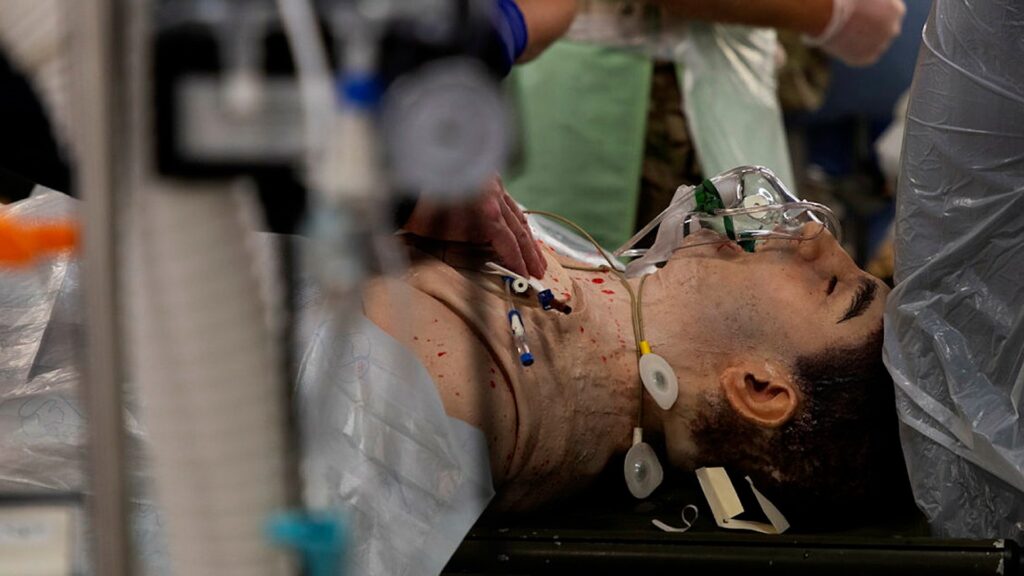
A realistic training mannequin invented by Professor Pallister being operated on. Credit: MoD.
The SAM model offers military medical teams an immersive experience in trauma surgery.
It has the unique capability to replicate a wide range of injury patterns, including blast wounds and gunshot injuries.
This makes it an invaluable resource for military surgeon training.
To enhance the lifelike experience, the SAM model can ‘breathe’ and simulate bleeding by pumping artificial blood.
Over a decade, Professor Pallister meticulously refined and developed the mannequin to become an essential tool for Armed Forces medical teams seeking to train at the highest level of realism.
In this instance, the mannequin took centre stage in a clinical exercise organised by the Army Medical Services Training Centre (AMSTC).
Earlier versions of the SAM model have already been used to train Ukrainian military surgeons, underscoring its international relevance and impact.
Dr Andrew Murrison, the Minister for Defence People, Veterans and Service Families, who also serves as a doctor in the Reserves, expressed his admiration for this innovative equipment.
He said: ‘These world-class training models are an excellent demonstration of the type of innovative equipment produced by UK defence and our industry partners. They play a vital part in delivering cutting-edge training to our Ukrainian allies and our exemplary military medical and surgical teams in the UK, helping to ensure they continue to be the very best at what they do.’
Professor Pallister's creation draws on CT scans and 3D-printed models of specific wounds, such as gunshot and pelvic injuries, to achieve its unparalleled authenticity.
The latest iteration of the SAM model allows for intubation, the removal of simulated tissue and can facilitate exploratory surgery.
Sharing his insights on the development of SAM models, Professor Pallister said: ‘SAM models, which have been taken on board Royal Navy ships and deployed in land environments, are the product of years of constant redesign and redevelopment. These evolving innovations would not have been possible without the close cooperation of Defence Medical Service colleagues and the Defence Science and Technology Laboratory.’
Colonel Jonny Round, the Clinical Adviser for Deployed Hospital Care at Army Medical Services Training, added: ‘Traditionally at AMSTC, we’ve used a live casualty actor with some make-up to deliver a list of symptoms and injuries. Professor Pallister’s model simulates, very realistically, combat wounds requiring surgical intervention. The surgeons get to operate – and the entire team trains – in a field hospital replicating the one they will find themselves deployed to. We are immensely proud that we can deliver world-class medical teams to operations through this training.’
The introduction of the SAM model to military training exercises marks a significant advancement in preparing military surgeons for the complexities of combat medicine, ultimately ensuring the highest level of care for those in need on the battlefield.