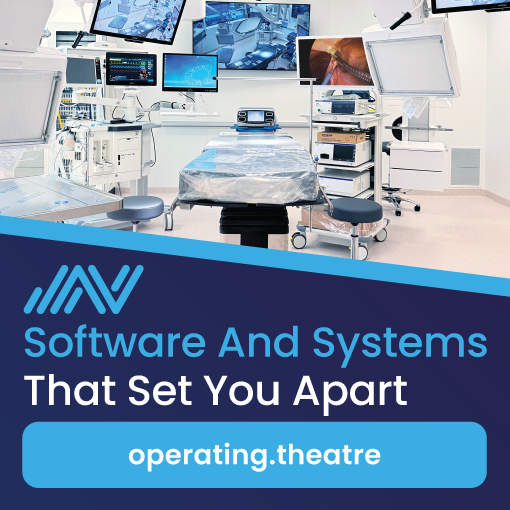
Digitizing the operating room is ‘happening on fronts we could only once dream of’
As innovators continue to push the boundaries of medical technology, integrating AI, XR and other cutting-edge tools in the operating room will revolutionise patient care and enhance outcomes in the years to come.
These were the takeaway messages from a webinar on ‘Digitizing The Operating Room’.
According to panel expert and world-renowned surgeon Shafi Ahmed, digital surgeons are rapidly embracing new technology to ‘make us better clinicians going forward’.
Rafael Grossmann added that the digitalisation of the OR is happening on all fronts. One of the earliest pioneers to bring digitalisation into the OR with teaching through Google Glass and virtual reality, he suggested transformation is impacting all areas in ways ‘that we could only dream of just a few years ago – and it’s coming quite rapidly'.
The webinar, hosted by Surgery International in collaboration with The Confederation of Surgery (CBS), Integrated Theatre of Things and Orascoptic, was the third webinar in a Talk Surgery educational series.
The panel included:
• Professor Shafi Ahmed, consultant colorectal surgeon, known for his pioneering work in medical education and digital healthcare.
• Stefano Bini, Professor of Orthopaedic Surgery, San Francisco, USA
• Marlies Schijven, Professor of Surgery and Digital Health, Amsterdam
• Rafael Grossmann, an advanced laparoscopic and robotic surgeon, Maine, USA
• Thomas Knox, Founder and CEO of Vitvio.
• Dr Ingo Aicher, MD of JAV Medical, a leading medical technology company specialising in innovative healthcare solutions.
Together, they delved into how the increasing digitisation of global operating rooms is helping to streamline workflows, improve communication and reduce surgical errors.
Focusing on the intersection of technology and healthcare, the experts discussed the evolving landscape within surgical practices – from using OR AI monitoring systems, including the black box, to the promising prospects of AI and XR in surgery.
Rafael emphasised the importance of balancing technological advancements with human-centric care. Recognising that technologies such as Apple’s Vision Pro and other devices from HP, Lenovo, and Meta are here to stay, he suggested it is essential to consider how they are being integrated and utilised.
Reflecting on a shift in perspective, he also highlighted the potential of XR (extended reality) to drive these significant advancements. In particular, he sees XR’s convergence with AI, gamification and the increasing accessibility of consumer devices as key to propelling its transformative potential.
He highlighted XR’s transformative capabilities, envisioning scenarios where patients receive psychological therapy through immersive experiences before surgical procedures.
He said: ‘We are at the end of the beginning because XR now is not just XR but XR with LLM algorithm, with generative AI embedded in XR images or avatars. You can have a smart conversation with an entity about anything. You could be a patient on the table, and you getting psychological therapy to deal with your anxiety from the operation before the operation. I used to say XR is for education and diagnostics, but it’s been more than proven and validated that XR for treatment in medicine is real.’
‘In the OR, we were always very late to the game. But now we are seeing technologies like XR helping the organisational part of the operating room – the hundreds of instruments and hundreds of steps – to try to organise everyone’s game in a way that makes sense.’
He noted the various companies already using XR tools intraoperatively to enhance rather than substitute existing tools and to augment the human surgeon and commented on the impact of XR images that have sub-millimetric precision that helps mostly neurosurgical or orthopaedic surgeons carry out a biopsy or organise the angle of attack for a cut or a perforation.
He also recognised the AI component that offers algorithms that help with data – real and synthetic.
‘I think the digitalisation of the OR is going to many other fronts that we could only dream of just a few, maybe two or three years ago, and it's coming quite rapidly.’
Meanwhile, Marlies Schijven emphasised the need to integrate technology seamlessly into medical workflows. She stressed the significance of identifying opportunities where technology can enhance patient care and team collaboration.
‘It is vital to see the opportunity matched with the problem, and if there’s no problem, there’s no opportunity, which is why I’m so interested in performing research in the digital health space,’ she said, highlighting the importance of leveraging technology to strengthen teams and improve outcomes.
She advocates for leveraging technology to enhance team dynamics and identify areas for improvement. Still, she acknowledges that the real challenge lies not in the technology itself but in establishing clear rules, boundaries and ethical considerations surrounding the use of data.
Despite assurances about privacy and data usage, individuals may still harbour concerns about being monitored. This is why regulations must be established to ensure technology serves its intended purpose without infringing privacy or individual rights.
She highlighted the need to convince people of the benefits of technology adoption, especially in culturally diverse contexts. She talked about various potential applications of technology, such as team training, research and AI algorithm development, while also recognising the importance of prioritising meaningful metrics over merely measurable ones.
Stefano Bini, a Professor of Orthopaedic Surgery, is a trailblazer in using wearable sensor data to create predictive analytics for total knee procedures and is helping to usher in the personalisation of treatment paradigms.
He shared what he saw in his latest travelling experiences – from South East Asia to the Middle East – to note that innovations sometimes happen in areas ‘you think are impossible to innovate’, seeing how people are addressing global challenges.
Thomas Knox is the founder and CEO of Vitvio, the first platform built around AI and computer vision to make operating rooms safer and more efficient.
He acknowledged that healthcare perceptions of AI and technology are changing, particularly in surgical operations.
Highlighting the initial concerns about technology being perceived as intrusive or resembling a ‘big brother’ concept, he emphasised that implementing such technologies is designed to streamline operations rather than micromanage.
The solution focuses on improving efficiency and reducing administrative burdens for medical staff by deploying cameras and analysing processes in operating rooms. He offered examples of how technology can optimise workflow and prevent delays, aiming to enhance patient care without adding pressure to clinicians.
Ingo Aicher, MD of JAV Medical, a company specialising in system integration, also discussed the importance of overcoming barriers to technology adoption and cited the need for comprehensive integration strategies to ensure successful implementation.
Regarding the role of AI in surgery, Marlies Schijven expressed cautious optimism about its current capabilities. While acknowledging its potential to support surgical planning and patient care, she emphasised the complexities of surgical procedures and underscored the need for further advancements.
The panel also discussed democratising new technologies to benefit communities globally.
Concluding the one-hour event, Rafael Grossman suggested that in the most developed economies, XR and AI are expected to play a pivotal role in surgery and healthcare but, at the same time, acknowledged that significant changes might not occur in the next decade, emphasising the need for long-term thinking.
The discussion concludes with gratitude to the panel and an invitation to the next webinar on surgical leadership, highlighting its importance and the lack of training in this area.
You can watch the entire webinar for free here.