A woman with a rare double uterus has delivered two daughters in what doctors are calling a ‘one-in-a-million’ pregnancy.
Kelsey Hatcher, 32, from Alabama, had her babies at the University of Alabama at Birmingham (UAB) hospital.
On Instagram, the hospital posted: ‘Having a double uterus is a rare phenomenon, and conceiving in both at the same time is even more so. In an exceptional pregnancy, UAB Medicine patient Kelsey Hatcher successfully delivered two healthy “twin” daughters from separate wombs, with a 10-hour gap between each birth – resulting in the incredible twins having different birthdays.’

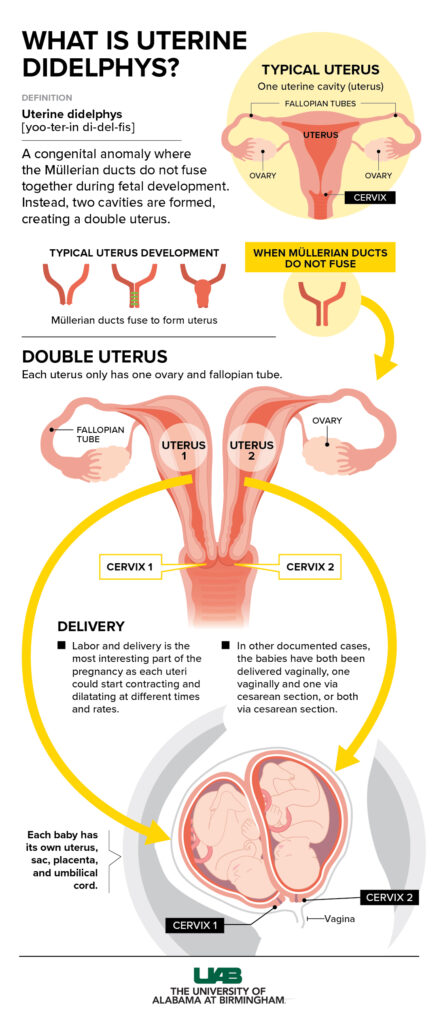
When Kelsey was 17, she was diagnosed with a double uterus – uterus didelphys – a rare congenital anomaly that occurs in 0.3 per cent of women. The condition occurs when the Müllerian ducts fail to fuse together and subsequently form two uterine cavities, often called ‘horns’.
Each uterus has one fallopian tube and one ovary. In Kelsey’s case, she also has two cervices.
A few weeks into her fourth pregnancy, Kelsey noticed some bleeding. Since women with a double uterus are at a higher risk of miscarriage, she made an appointment for her first ultrasound.
After the UAB ultrasound showed the baby was doing well, Kelsey asked her to check her second uterus for good measure.
Kelsey’s obstetrician, Shweta Patel, assistant professor in the UAB Department of Obstetrics and Gynaecology, was in disbelief at the discovery until she could look at the scans herself.
While it is not as uncommon for women with a double uterus to have a pregnancy with one baby in one uterus, as Kelsey had carried three times before, having a baby in both – also known as a dicavitary pregnancy – is an estimated one-in-a-million chance.
She said: ‘I had already taken care of Kelsey through her third pregnancy and knew she had a double uterus, but that was only one baby – two babies in two uteri were a true medical surprise. I knew I would need additional expertise. Luckily, I could reach out to my UAB maternal-fetal medicine colleagues who specialise in high-risk obstetrics cases and unique pregnancies.’
Richard O Davis, professor in the UAB Division of Maternal-Fetal Medicine, who co-managed Kelsey’s pregnancy, said: ‘In a typical twin pregnancy, the twins share one womb, which can limit the amount of space each has, making preterm or early birth a high possibility. With Kelsey’s babies, they each had their own womb, sac, placenta and umbilical cord, allowing them extra space to grow and develop.’
Due to the rareness of dicavitary twins, Patel and Davis had only a handful of case reports to study and use to guide a delivery plan.
In some cases, both babies were born vaginally; in others, the cervices would dilate only to a certain point, thus resulting in a double caesarean section. There were also cases where one uterus went into spontaneous labour and the other did not.
The team knew there were three potential delivery scenarios:
- Both babies delivered vaginally
- One baby delivered vaginally, the other delivered via C-section
- Both babies delivered via C-section.
Patel said: ‘While C-sections may be a more controlled delivery option for high-risk cases like this one, we did not want to jump to the third plan immediately, knowing Kelsey’s history of successful vaginal births from both uteri. We also listened to Kelsey’s wishes. She wanted to aim to have the same birth experience for the girls as her other children, if safe and possible.’
After the successful deliveries, patient Kelsey posted on Instagram: ‘Our miracle babies were born! They decided they were rare enough statistically that they should just go ahead and have their own birthdays, too. Roxi Layla was born Tuesday night 12/19 at 7:49pm and was joined by her sister, Rebel Laken, Wednesday morning 12/20 at 6:09am. Our team at UAB was incredible, and we couldn’t have had a better experience! I can’t wait to share the entire birth story with you guys! While we are all home now, we will take the time to bond, recover, and enjoy the holidays!’
You can watch the team discuss the case here.
Left: Baby A, named Roxi, was delivered vaginally on Dec. 19 at 7:45 p.m. weighing 7 pounds 7 ounces. Right: Baby B, named Rebel, was delivered via C-section on Dec. 20 at 6:10 a.m., weighing 7 pounds 3.5 ounces. Photography: Andrea Mabry